
How to Choose a Dissertation Topic in 2026

This year, a dissertation will demand more than just academic knowledge; students will also need e-literacy, an effective strategy, and a proper understanding of how to filter out distractions and discover the best available evidence.
If you’re curious what a dissertation is and how to pick a path for such a tricky and lengthy task, this is exactly where you need to be.
In this guide, we’ll cover the steps to pick your dissertation topic, which is rewarding, relevant, and researchable.
What Is a Dissertation?
A dissertation is a deep-dive piece of academic writing, depending on the original research carried out by you. Generally, it is submitted as the final step to complete a degree.
Writing an effective dissertation involves discovering a particular question or a topic thoroughly, doing independent research, collecting, analysing, and interpreting data, and then sharing results in a structured way. If you can’t figure out what it is or feel stuck halfway through your draft, there is always the option of going for dissertation editing services.
Importance of Picking the Right and Engaging Dissertation Topic
Choosing an effective topic assures a successful and productive dissertation journey. It could have a significant impact on your overall academic success and workflow. Below are the key advantages of picking the right dissertation topic:
- You’ll stay motivated and enjoy working on your dissertation throughout the journey.
- A well-selected dissertation topic that corresponds with the academic expectations and program requirements significantly increases the opportunities for higher grades.
- Access to enough literature, data, and resources makes finishing your dissertation manageable.
8 Tips for Selecting a Dissertation Title That Will Surely Make an Impact
For a successful dissertation, not all ideas pan out. In this guide we willshare a few tips and tricks that make sure the research will be well-supported, meaningful, and manageable.
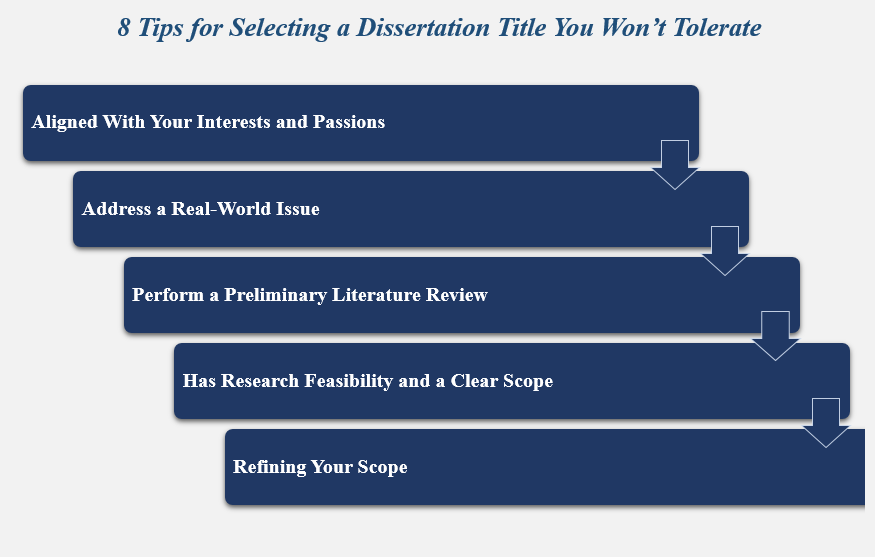
1- Aligned With Your Interests and Passions
A topic that highlights your professional and personal interests will keep you encouraged during the dissertation journey. Reflect on the themes or concepts during your studies that trigger enthusiasm and curiosity. Ask yourself:
- What questions and problems do I find myself thinking about outside of the class?
- What themes do I enjoy learning and reading mostly?
Students who select topics that are not aligned with their passion or interest often become demotivated at the end, and start to research “write my dissertation for me” when time is running out.
2- Address a Real-World Issue
A successful dissertation topic is grounded in practice. Your research must have the capacity to make a significant impact on practices, management strategies, or policies in the field. Look for:
- Controversies and debates in policies.
- Topics with insufficient research in your area.
- Severe challenges organisations, peers, and leaders are facing in your industry.
Addressing real-world issues could attract greater academic interest and reduce the likelihood of revisions or reliance on academic writing services.
3- Perform a Preliminary Literature Review
Initiate with reading broadly in your field or area of interest to understand what research has been performed. Consider:
- Books: These give an extensive overview of the topic and theoretical frameworks.
- Academic Journals: Peer-reviewed articles mainly mention unresolved questions, current trends, and debates.
Once you’re done with the literature research, consider under-researched areas and where current theories could be implemented in innovative ways. A research gap might be:
- A context or population that hasn’t been researched, such as regions or a particular age group.
- An unresolved question in your field, like the impact of a new policy or new technology.
Your literature review will definitely suffer if sources are scarce, which is one of the major reasons that the majority of individuals turn to online help for learning support.
4- Has Research Feasibility and a Clear Scope
A promising thesis topic is one you can realistically discover within the resources and time available. Certain topics, while thought-provoking, might be logistically impossible to finish within the constraints of your degree. Reflect on:
- Can you gather data efficiently and ethically?
- Can you answer the research question within the timeline of your program?
- Do you have access to the target population you are willing to research?
5- Refining Your Scope
After considering general areas of interest, you can begin narrowing your focus. It’s extremely necessary to stop selecting a thesis topic that’s so broad that it lacks depth or it lacks focus. Narrowing your research focus at an early stage assists in avoiding being overwhelmed later.
For instance, if your dissertation’s focus is on education, try polishing your topic by investigating:
- Educational contexts, including urban charter education or rural elementary.
- Student population, such as gifted learners or learners with disabilities.
6- Seek Guidance
After completing all the aforementioned steps, the next step is to get feedback from mentors or advisors. This assures your research is accepted by your institution and is academically sound and focused.
Exchanging thoughts with experienced peers, professors, or academic advisors is critical. They might:
- Discover potential ethical considerations or methodological issues you might not have identified.
- Offer constructive feedback on whether the topic is researchable and feasible.
- Suggests ways to identify additional research gaps or to refine your focus.
For example:
If you aim to figure out the impact of AI on education, your professor might suggest fine-tuning your focus to a particular application, like AI-powered writing assistance tools in educational institutes, instead of studying AI in education broadly.
7- Create an Attractive Research Question and a Working Title
It is important to make a few research questions and write a working title once you’ve polished your dissertation topic. This will help you clarify your research focus and secure acceptance from your research committee or a professor.
Below are a few tricks:
- Prevent vague phrasing or jargon
- Keep your research title specific and descriptive
- Research questions and objectives must be answerable, explicit, and in line with your selected research method
8- Receive Formal Approval
Most programs need a formal research prospectus or proposal before starting the dissertation. This generally includes;
- Your working title and topic
- Research aims, objectives, and questions
- Methodology and plan for data collection and analysis
- Expected outcomes
Presenting your research proposal ensures that your committee or professors approve your research topic and confirm that your study fulfills academic standards.
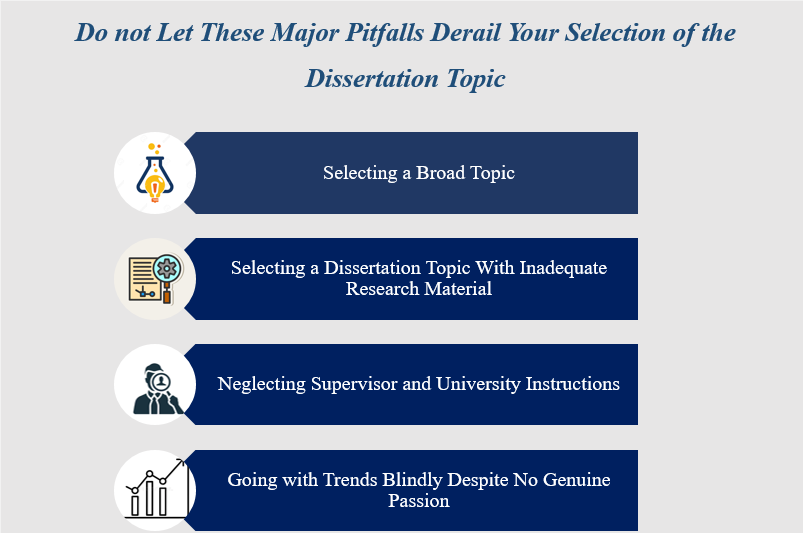
Do not Let These Major Pitfalls Derail Your Selection of the Dissertation Topic
Here are a few common errors many learners make and how to prevent them:
- Selecting a Broad Topic
A broad dissertation topic, while it might seem exciting initially, could immediately turn into overwhelming. Covering too much on a single topic could make it challenging to perform focused research.
For instance,
Rather than using the topic “The social media’s impact on society”, polish it to “The impact of Instagram on social comparison among university learners in the UK.”
2. Selecting a Dissertation Topic With Inadequate Research Material
Certain learners select dissertation topics that lack accessible resources, data, or literature. Your research might be incomplete, without sufficient material.
Pro tip: Before submitting your topic, perform a preliminary literature review to ensure there are ample details to support the research.
If you pick something that has limited research or is too complex, you will end up needing cheap dissertation help UK.
3. Neglecting Supervisor and University Instructions
All universities provide sufficient instructions on the structure of the dissertation, scope, and word count. Not following these guidelines could lead to wasted efforts.
Pro Tip: Students should review their university’s dissertation handbook and consult their advisors prior to finalising their research topics.
4. Going with Trends Blindly Despite No Genuine Passion
Trendy research topics might appear attractive; however, if you’re not truly interested in them, keeping momentum over months could be extremely difficult.
Pro Tip: It is essential to link your research topic with both your career goals and interests to stay engaged throughout the dissertation journey.
Examples of Some Inspiring Dissertation Topics
Below are some sample dissertation topics to get you started, if you’re having an issue with exploring the inspiration you require:
- The impact of mindfulness interventions on mitigating urban-student stress in the UK
- The generative AI’s impact on high school student engagement in the UK
- A qualitative research on the impact of transformational leadership style on staff turnover in hospitality
- To examine the digital literacy in online health information seeking
FAQs
Q1. Should my dissertation topic link with my current job?
It is not required, honestly. However, it’s beneficial if it does, as you’ll have easier access to data and a more robust understanding of the context.
Q2. How can I make my dissertation topic highly impactful and unique?
To make your dissertation topic impactful and unique, always aim to explore the research gap. For instance, rather than researching general “Employee productivity at work”, you should concentrate on the particular aspects, like employee well-being measures or remote collaborative tools.
Q3. What happens if I can’t find any proper sources for my dissertation topic?
Insufficient sources may indicate that the dissertation topic is underdeveloped or too obscure to be a completed dissertation. Thus, you might need to adjust your dissertation focus.
Q4. Can I modify my dissertation topic afterwards?
Definitely, you can transform your research topic; however, only in the early phase. Frequent changes, however, could delay your overall development and demand additional approvals.
It Is Time To Make The Right Call And Pick A Great Topic For Your Dissertation
You have enough time for the research. We have shared all the relevant details and insightful tips that will help you in finalising the right topic for your dissertation. Starting early and beginning with brainstorming can be the key that will make your academic journey easier.