
Confused by Harvard and OSCOLA Referencing? How to Avoid Easy Mistakes
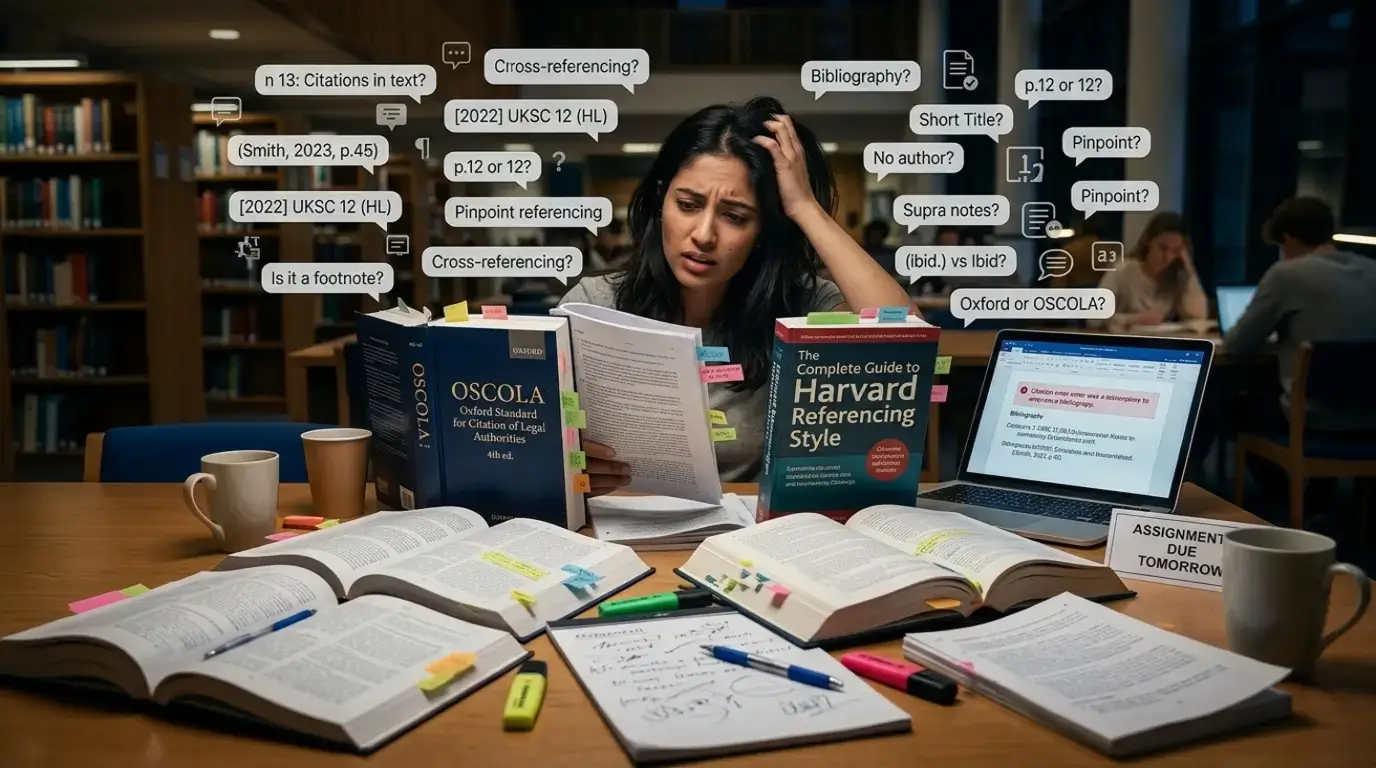
Most students spend hours finding sources, building arguments, and polishing paragraphs while they completely forget about referencing. Then, somewhere near the deadline, they turn their attention to citations. What should be a straightforward task suddenly becomes a source of frustration.
The most common thoughts during this time are:
- Was the author’s name supposed to go in brackets?
- Should the page number appear in a footnote?
- Does the bibliography need to be arranged differently?
These questions become even more confusing when students are asked to switch between Harvard and OSCOLA referencing styles.
Continue reading to know the core differences to submit a paper that meets the expectations of your tutor.
Why Referencing Errors Matter More Than Students Think
Students view referencing as a technical requirement rather than an academic skill while completing their assignments.
Unfortunately, markers often see it differently.
Poor referencing can create several problems, such as:
- Sources become difficult to verify
- Academic credibility suffers
- Arguments appear less reliable
- Marks may be deducted for incorrect formatting
Even when the research itself is strong, careless referencing can leave an impression that the work was rushed.
At this point, students have two options available.
Either they can ask a professional to do my assignment, or consider referencing as the academic equivalent of a presentation, because a well-researched assignment deserves accurate citations.
Everything You Need To Know About Different Referencing Styles
Referencing styles work differently, and mixing the rules of one with the other can quickly cost valuable marks.
However, most referencing mistakes are surprisingly predictable. Once you know where students usually go wrong, they’re much easier to avoid.
The mistakes below appear in assignments every semester
- Treating Harvard and OSCOLA as the Same System
A wrong assumption is that all types of referencing methods are the same.
In reality, Harvard and OSCOLA were designed for different academic purposes.
The Harvard system is popular in numerous fields such as business, education, social sciences, and others. It makes use of in-text citations that are incorporated within the body of the work.
For example:
Leadership styles often influence workplace performance (Smith, 2023).
A business student moving into a law module usually notices the difference immediately. Harvard keeps citations inside the text, while OSCOLA pushes them into footnotes.
In the OSCOLA referencing, a statement in the text is followed by a small superscript number, and the source information appears at the bottom of the page.
Also, students who switch between modules often find themselves accidentally combining both systems without realising it.
2. Harvard Referencing Mistakes That Appear Again and Again
Certain errors show up so frequently in assignments that it becomes extremely easy for the lecturers to spot them within seconds.
A common issue involves missing page numbers when quoting directly.
Consider this example that can help you write a Harvard referencing assignment correctly:
Incorrect:
“Effective leadership requires trust” (Brown, 2022).
Correct:
“Effective leadership requires trust” (Brown, 2022, p. 45).
Without a page number, your lecturer knows where the quote came from but not where to find it.
Another frequent issue is inconsistency.
A student may cite one source as:
(Jones, 2021)
Then cite another as:
Jones (2020)
Both approaches can be correct depending on context, but inconsistency across the paper often signals a lack of attention to detail.
3. The OSCOLA Footnote Problem
OSCOLA presents a different challenge. Students clearly understand that footnotes are required, but struggle with what information belongs inside them.
Legal sources often require very specific formatting.
A case citation, a legislative reference, and a journal article may each follow different rules.
Suppose you are referring to the case of Donoghue v Stevenson. In OSCOLA, the citation would appear like this:
In the text:
The modern law of negligence developed significantly through the landmark case of Donoghue v Stevenson.¹
Footnote:
¹ Donoghue v Stevenson [1932] AC 562 (HL).
You can see how the source information appears in the footnote rather than inside brackets within the main text.
The format looks slightly different for a journal article.
Footnote:
² Sarah Green, ‘The Evolution of Contract Law’ (2023) 15 Legal Studies Review 45.
These examples illustrate why students sometimes struggle with OSCOLA. Different source types follow different citation structures, which makes consistency particularly important.
In most cases, students just copy and paste their citations from online sources, not thinking about their compliance with OSCOLA rules.
As a result, a mixture of citation styles is found in the text.
One properly formatted footnote followed by three incorrect ones is one of the most common mistakes visible in law assignments.
4. The Bibliography Isn’t Just an Afterthought
Students often risk their marks by rushing the bibliography section. After completing an assignment and learning about how to do Harvard Referencing in simple steps, they are eager to submit and move on.
The bibliography receives whatever attention remains.
This is the approach that creates problems.
A strong bibliography should match the sources cited throughout the paper.
- If a source appears in the text but not in the bibliography, it instantly creates confusion.
- Likewise, a bibliography filled with sources that never appear in the assignment can raise questions about whether they were actually used.
This is why you need to compare your references against your bibliography line by line after the completion of your assignment.
It takes a few minutes and can prevent avoidable mistakes.
5. Small Formatting Errors Add Up
You might feel tired during the proofreading stage. That’s usually the moment when a missing comma or misplaced bracket may seem insignificant.
Collectively, those small mistakes create an impression of carelessness.
This scenario is extremely common when you are completing assignments without reviewing a detailed and simple guide to Harvard Referencing for UK university students.
Consider how quickly these issues accumulate:
| Common Error | Potential Impact |
| Missing page numbers | Incomplete citation |
| Incorrect italics | Formatting inconsistency |
| Wrong publication date | Source confusion |
| Missing footnotes | Referencing error |
| Incomplete bibliography entry | Lost credibility |
Students often focus on major referencing rules while overlooking these smaller details.
Fortunately, most of these issues are easy to fix.
6. Blind Trust in Reference Management Software
Universities frequently encourage students to use citation tools. These tools can save significant time.
However, they should never be treated as automatic solutions.
Reference generators occasionally produce:
- Incorrect formatting
- Missing information
- Outdated citation styles
- Incomplete references
This is why the use of a citation tool should be viewed as a starting point rather than a final answer.
You should always review the output before submission, as a quick check can prevent multiple referencing errors from slipping into the final document.
Why Students Struggle When Switching Between Subjects
A business student may spend months using Harvard referencing before enrolling in a law module that requires OSCOLA.
The adjustment can be frustrating when you are dealing with the major differences between Harvard, APA, or MLA referencing styles.
But the issue isn’t intelligence. It’s their habit.
Once a referencing style becomes familiar, students begin applying its rules automatically.
That habit becomes a problem when another system enters the picture.
The best approach is to think of Harvard and OSCOLA as two separate languages.
Both communicate source information, but they do so using different rules and structures.
Trying to combine them usually creates confusion.
A Simple Referencing Check Before Submission
You have to ask yourself the following:
- Are all your citations listed in the bibliography?
- Are all the quotations appropriately cited?
- Are the page numbers placed correctly?
- Is there a consistent referencing style throughout?
- Are footnotes formatted correctly?
These questions may not help you catch every mistake, but they’ll certainly help you avoid quite a few of them.
When You Can Benefit From Professional Guidance
Referencing becomes somewhat difficult when the level of academic work becomes advanced.
The work on dissertations, legal essays, research papers and postgraduate assignments usually includes the use of tens of different sources. And at this level, some mistakes become more difficult to catch.
That’s why many students opt to get advice from their tutors or cheap assignment help UK before submission.
A second opinion can reveal mistakes that seem invisible after hours of editing.
Your task isn’t only the removal of mistakes from references. Instead, it is to make sure that the research style gets the treatment it deserves.
Solving Your Confusions
-
Can I use a citation generator for Harvard and OSCOLA referencing?
Yes, but remember to check the result. Such programs are very convenient, but sometimes they generate mistakes in formatting.
-
What happens if I accidentally mix Harvard and OSCOLA in the same assignment?
The mixing of referencing systems will incur formatting penalties and make verification of sources difficult since most universities require the same referencing style for the whole document.
-
Is OSCOLA used only for law assignments?
Though OSCOLA is mainly linked with law schools, there are other disciplines where it is used as well.
-
Does the lecturer check all references?
No, not necessarily, but many lecturers are able to detect the inconsistencies present. Incorrect referencing can easily harm the overall quality of your assignment.
-
Can referencing errors be considered plagiarism?
Incorrect citing may lead to plagiarism issues sometimes when sources are not cited, and authors are not acknowledged properly.
Wrapping Up
A reference error occurs due to a misunderstanding of the rules and rushing at the last minute. Harvard and OSCOLA referencing styles have different rules, and inconsistencies usually arise from their mixing. Regular practice and understanding the logic of each referencing style will help you to improve fast.
Therefore, the next time you will proofread your assignment, do not consider referencing as the final step in its preparation. On the contrary, you should perceive it as an integral part of academic reasoning. Checking your citations for ten minutes more before submitting an assignment can save you plenty of marks!

I am the professional academic writer behind the Assignment Ace blog, where I share simple tips to help students feel more confident with their assignments. I write about planning, research, writing, referencing, and the small things that make a big difference in academic writing. My aim is to provide university assignment help. Whether it’s an essay, report, or coursework project, my posts are written in a professional way so students can understand what to do, how to do it, and how to do it better. On the Assignment Ace blog, you will find easy advice, helpful guides, and academic writing assistance made for students who want to improve their work and stay on track with deadlines.